We paid our rent to Alaska dearly that summer. The most beautiful places in the world charge the highest. Alaska charges the most. The landscape will bring you to your knees, but in turn you will pay in weather, darkness, cold and sanity. I spent those short summer months in a rainy town building a hospital.
Day after dreary day was spent under a sky convinced it needed to turn the ground to sea. The crew I worked with were a hearty few, however and took it all in stride. Of course I didn’t, but I made a few friends and they helped ease the burden.
Sometimes during the darkest, wettest days I looked toward a sun-filled Rome, my next trip. I sat there in a man lift nailing off sheeting and mentally packing my bags.
We spent drenched days erecting huge glulams with cranes, setting joists and trusses high into the air and sheeting the roof with heavy plywood in blowing winds. One day a gust was strong enough it ripped a man’s tendon in his elbow. The sheet of plywood flew from his hands. I watched him reach for it a second before dropping to his knees. He tried desperately to not be useless to us, and succeeded well enough that we couldn’t justify sending him home.
When the temperatures began to dip I started packing. Rare is the trip I bring more than a carry-on. On this trip I brought two checked bags.
Rome was an old, well-worn, but strong town. It reminded me of a builder’s hands, with their calluses. I landed before Anna did. A rush of hot air caught me as the airport doors opened to the cab stand. I felt the bone-deep wet wick away as my shoulders straightened. I shot a video of the long taxi ride to Trastevere, a neighborhood known to food aficionados everywhere. In those days though, only a few of the old osteria remained. Most of the “ristorante” were in name only. Their menus were offered in English and pictures, while the prices were as outrageous as the food was bland.
It was no small matter to the locals, who would enthusiastically explain their dire dilemma. I had discovered a place the last time we visited the Eternal City though, and the wait time was short. So I made my way there.
The old street’s stones clacked back against shoes as I carried my two mountain packs a few short blocks to find the flat we had booked for the night. Wheeled luggage on old cobblestone often found themselves broken. They were a poor choice, and so I carried my belongings on my back. It helped remind me to keep my load small.
The building we were renting our flat in looked like every building in Rome. As a west coast American, I was very used to homes and residences being obvious: this building is obviously apartments, this building is obviously a house. In Roma, stand alone homes were rare. Most flats were hidden behind giant doors and courtyards. It was a relic to older times.
The flat was a sweat-inducing three floors up. An open floor plan revealed a kitchen first, then a living area with french doors that opened to a balcony overlooking the square. Below I could see tourists mingling near a fountain. They clutched espresso and gelato in the afternoon sun. Stinky, noisy delivery trucks expertly wove through skinny street and crowd.
Hustle and bustle was different there than Hong Kong or New York. It was leisurely. People had things to do and places to be for sure. It was just that Italians knew the places and things would be there. There was no rush. The air in the apartment was stuffy and warm. When I clicked the doors open they swung gracefully, but noisily inward. A rush of street noise, cool air and the scent of late lunch flooded my senses.
Oh Roma. My stomach gurgled expectantly.

After a quick night of restless sleep in the city, we took a taxi to the Tiburtina. The driver was an eccentric woman, based solely on the interior of her Fiat. It was covered in figurines, catholic icons and cat merchandise. Anna leaned over to me, with “Please can we visit the cat sanctuary when we come back?” I tried to hide my ever growing excitement at the thought of coming to one of the oldest cities in the hemisphere, rich with history, culture and pride only to visit a bunch of worm-infested strays.
“I guess,” I replied.
The Tiburtina was mostly for locals. Anyone was welcome to travel via the bus system, and it was in fact a great way to get about the country, especially in the south of Italy, where rail lines ran down the eastern coast, and across to Naples, but neglected much of the more beautiful spots. Still, there was nothing flashy about the bus station. It could have been a bus station anywhere. It had the international homeless, the poor, and one convenience store. Which yes, did sell ready-to-eat pasta and pizza. No, it was not good.
The road to our town was a serpentine one. The bus didn’t go all the way. Once we arrived in the province capital, we had to take another cab, roughly 50 euro and a 45 minute ride, to get up the mountain. Luckily, this time, we had friends who were willing to give us a ride.
I tried to close my eyes and sleep but the road offered such views that I could not. We passed by centuries, even millennia of history on our route: farms older than America, towers from the 1300’s, Roman villas, medieval castles, ancient villages and thundering mountains. The elevation creep caused our ears to plug and then to pop. Our only stop was at a convenience store so the driver could smoke. I’m not sure why he did though. He was happily smoking with the window down the entire way. It mattered little.
We arrived in the capital, a little sore, but still chipper. I always sweated and felt filthy when I traveled. I never felt clean until the next day. Our friends, Patrizia and Francesca, were waiting. We were renting an ancient home from Patrizia, and Francesca was her daughter. We had met the first time we came to our town. We stayed in Patrizia’s house and fell in love with it. It was in the heart of our small village and had three floors. The first floor was the kitchen, dining and bathroom. The middle floor the living room, and the top floor a changing room, bedroom and the tiniest of bathrooms. It was a small, and honorable home.
Francesca spoke English better than most Americans. She had been tutoring her mother in English, who when we first arrived two years prior, could barely speak a word. We conversed mostly through Google Translate. It was a marvel of software engineering and a godsend to the illiterate travelers of the world. This time however, we were able to converse amazingly well. Her English had improved so remarkably, and our Italian? Well I could say “bathroom” in a pinch and we’ll leave it at that.
Patrizia took us into her brood in the most motherly of ways. She walked with the confidence of a cop, often opening doors next to signs that demanded they stay closed. If she needed something, she would get it. She was a grizzly bear when it came to looking out for her children, both born and adopted. I was in more than one office when she gave a dressing down to government officials, leaving them red faced and speechless. Often, begging our pardon the next time we met. She was kind and gentle, though not someone one wanted to be on the wrong side of. She was determined, bold-hearted and proud.
Contrast to her daughter Francesca, who was bashful at first. She had the looks of her mother, with a piercing gaze, and youthful optimism. Though she was light-hearted and gentle as we got to know her. The only time I saw true fire in her blue eyes was when I teased that American pizza was better than Neapolitan. “I cannot even talk to you right now.” she said with the anger of Bellona. “American pizza cannot be called pizza. It is cake.” She shook her head with disdain. There was the strength she inherited from her mother. I cowered a little.
“I’m just saying. I think we took it and made it amazing.”
“You are stupid.” She said bluntly. Checkmate.
The ride up the mountain was filled with catching up. We had only met them once before but it was like settling into a well worn, comfortable shoe again. We were trying a new coffee shop. The rings under my eyes had betrayed my exhaustion. We ordered dessert and espresso. The sugary pastry slid effortlessly past my taste buds. It was angel’s food. The strong, savory espresso sprang life back into my bones. We chatted for a bit and made plans to catch up the following days at the table. We had yet a ten minute trip up the mountain to reach our home for the next few months. We arrived in the dark. Patrizia climbed out the car. We embraced and said goodbye for the evening. “It is so good to see you again.” Patrizia said. “Buona notte. Get some sleep.”
The region was a hilly, mountainous one. It could have earthquakes. Winding roads with little room moved the denizens from one village to another. It was unpopular compared to the tourist hotspots of Firenze, Roma, Milano and Napoli. The rain would come now and then and with it, vicious wind. We were at the peak of the mountain and it would blow against the shutters. The rain would search for any nook and cranny.
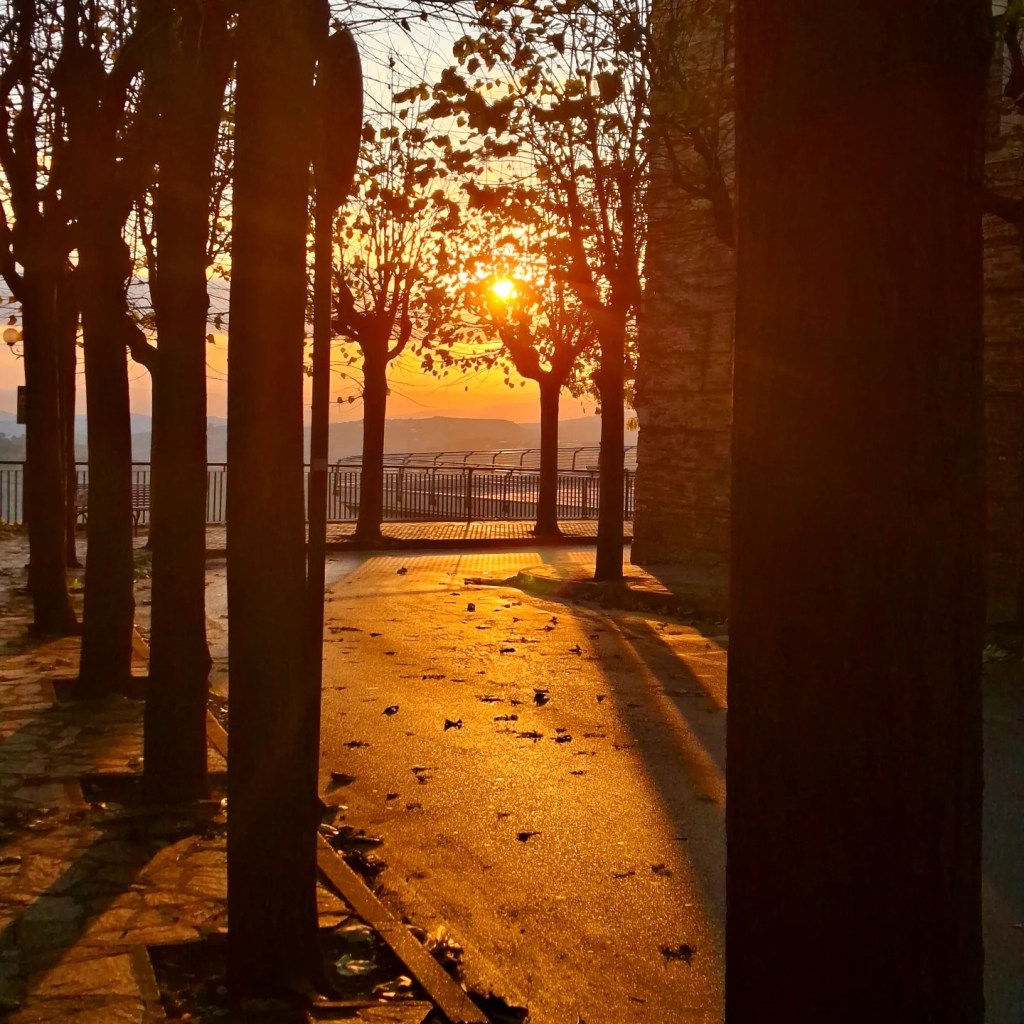
The village was somewhat cutoff from the coast, only intrepid tourists with time to spare would make their way there to this town of 9500. It boasted the best views of the region. The tallest peaks around stretched to the sky in the north, and the hills slowly dropped down to the sea to the east and stretched down to the south.
Anywhere there, you were either walking up a hill or down one. Level ground was for the lazy folk down below. They said there was a law, that as long as you were not disturbing the peace or damaging valuable crops or property, you were allowed to walk anywhere. It was a romantic notion, but not one that this foreigner tried often. It was not easy to argue legalese in a language you did not speak. “Bagno, per favore” wasn’t a sound legal argument. Still we trekked many a mile during that fall.
The village itself had many alleys and side streets. It was a medieval town, and thus the streets meandered with a few that ran the entire length.
They all led somewhere though, whether it was the main square, piazza with the church, nearly a thousand years older than the state I live in in America, or the city gate which had stood through two world wars, and dozens of smaller skirmishes, or the city park with a gorgeous walking bridge overlooking the tumbling hills below. The main street, aptly named Roma, held all the shops the surrounding locals came to buy. Clothing, vintage wine, baked goods, electronics, butchered meat, tools and household goods were all sold there. It was strangely urban, tucked away and hidden behind intimidating walls. I felt the curiosity of a child, pulled toward what hid in them.

The tiny streets filled with cars only for a few hours at a time, mostly when the farmer’s market opened on the weekends. The Terrace near our favourite coffee shop filled with farmers and their produce, all grown locally. The locals moved about the tables and stalls. “Pesce fresco dell’adriatico!” A man called to us from his ice filled truck. Anna moved in. Damnitall I thought to myself, looks like we’re having fish tonight. We snacked on biscotti and cornetto as we meandered to and fro.
We were on vacation, so we “piano.” It was a word that meant many things in Italy. It meant floor, as in “quattro piano” or fourth floor. It also meant the instrument. But mostly I heard it in response to my American tradesman demeanor: “slow down.” “Piano, Piano!” Patrizia would call to me as I wolfed down the best pasta this side of Pluto. Or as I would hurriedly try to get through grocery shopping.
Shopping. There was a whole different game. Especially with a partner who had food restrictions. One quickly learned very specific useless-in-any-other-aspect-of-life words when grocery shopping. Words for unique ingredients like: benzoato di sodio. I digress from my subject, but these little nothings were very important eventually.
You found that, sure Italy was much like America except in the little things. The things that ended up mattering. And then suddenly alone in a supermarket in a small village on a mountain, this woman was speaking to you in the language everyone knew except you and pointing and growing frustrated that you were there shopping without an inkling of any knowledge ever.
You had a sudden realization that you were the foreigner, and you wholly understood the word.