The first man I met from America was so obviously an American. He spoke with a southern drawl, a mountainous gut from good living and a Harley Davidson shirt. He used to be in the military. Some kind of radioman I think. He was called Jesse. But his Italian, Ohmygod, his Italian. The best, better than Dante Alighieri! Perfetta in ogni modo.
“We’ll meet you at the coffee bar,” he said over the phone. Anna had met his wife on social media and wanted to get to know them. They were retired now. They bought a sturdy house in a valley nearby. But the road to get there was winding and it took much longer than it should to visit. We did so frequently. Of course, Deborah asked me to work on her shutters. Of course I balked.
“Lots of people need a carpenter here. You’d have work as long as you wanted it.” She said. I stood there in her driveway next to an olive grove dreaming just for a moment.
“The American Carpenter” they’d say in the village. He did work for Antonio, fixed his doors. Doesn’t speak a word of Italiano. I’d show up with my tool bags with my American tape measure. Taking numbers in fractions while the nosy Italian neighbors tried to nonchalantly stand across the tiny streets smoking cigarettes and watching my every move. Not much new happens in an Italian village. They eye irregularity with the utmost suspicion. It’s their patriotic duty.
I wonder how many dreams I have killed in cowardice. We ate lunch with them and they cemented plans for Anna to watch their three dogs as they took trips in the future. The dogs were fine. They loved Anna and, like most trustworthy things, tolerated me as her lesser half. They drove us back to our Italian hovel with the leaky patio door after we gorged ourselves on sweets.
Much happens over food in Italy. Almost everything. Wars have been started, Emperors killed and families started during dinner. If one hits a bureaucratic snag, the best plan is to dine with the government official and their partner. Regale them with tales and laugh at their jokes and leave them with a bottle of wine around one in the morning. Everything will be smooth sailing after.
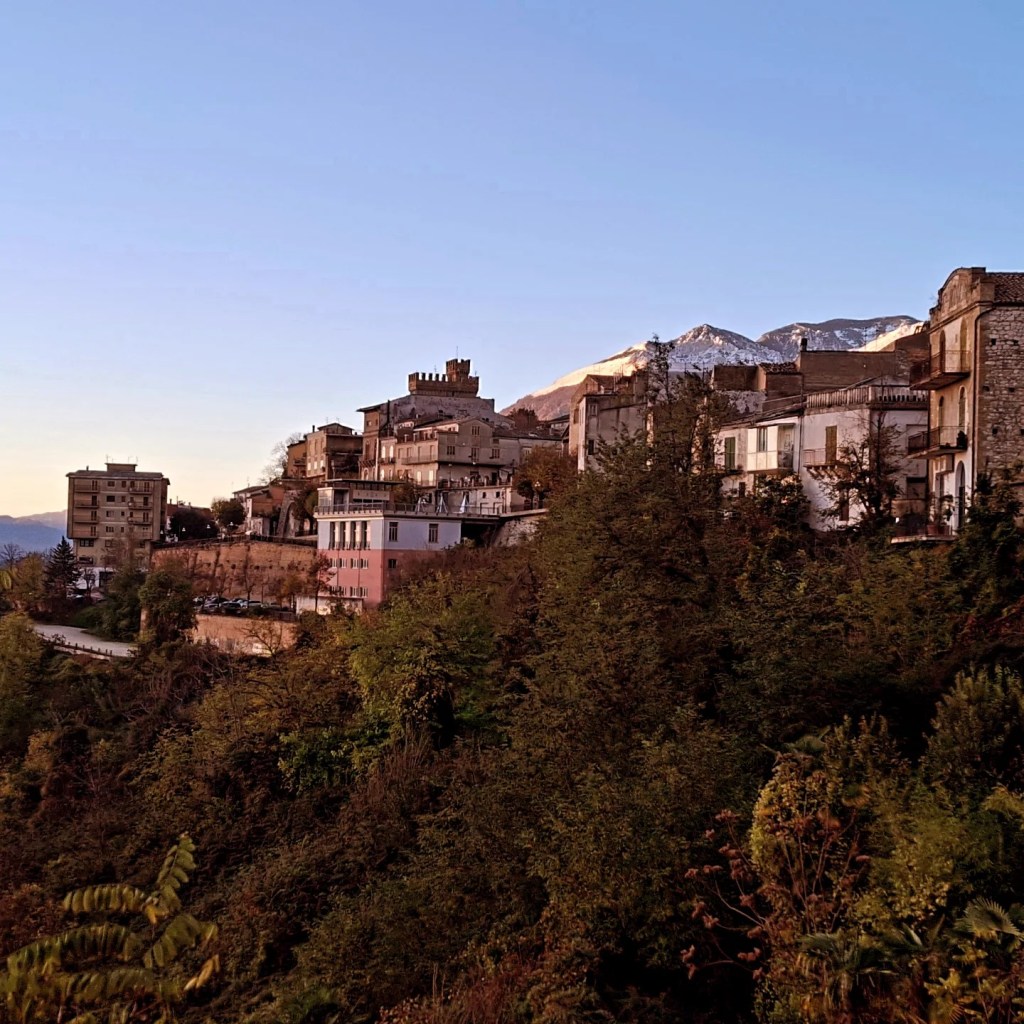
Christmas was officially started with the tree placed in the the central Piazza of our windy village. The square came alive in the evening with Abruzzesi Santas playing instruments, warm spiced wine and craft stalls. The kids would run down the cobblestone sing-songing in words I didn’t understand, while their parents meandered from group to group. It reminded me of church potlucks, except everyone was invited. I would sit on the cold stone steps of the church and slowly milk my wine.
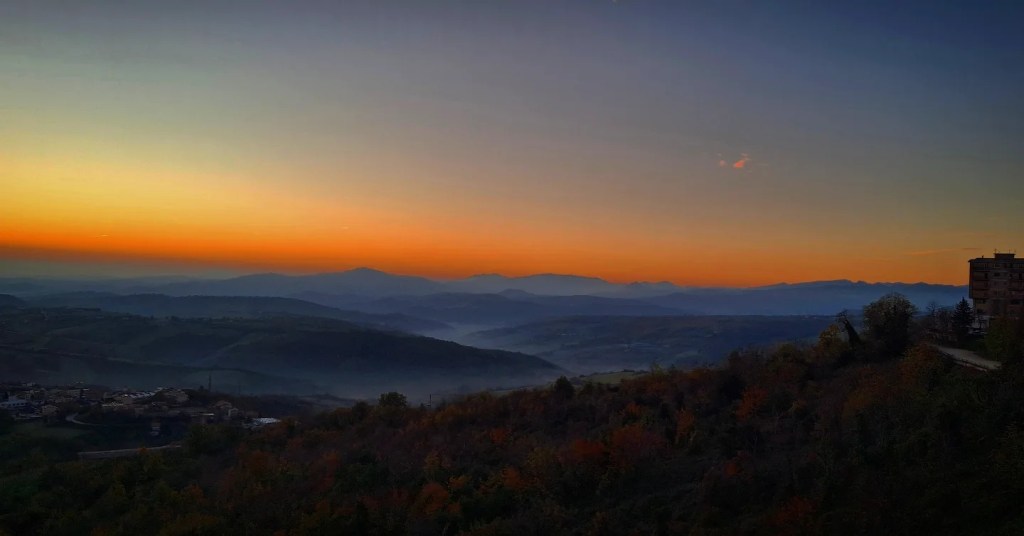
In the morning I’d wake early and leave Anna in the warm bed. I’d walk to the city park at the edge of the hill and watch the sunrise. The country tumbled down away from the terrace and the sun would announce itself long before it showed. The light would spill onto the hills and valleys like honey. The fog would be chased away in the immediate warmth. I wonder if Leone directed the sunrise sometimes. Then I’d walk back. I’d pass men who had gathered together on separate paths. As I passed the sugar scent of bakeries and coffee bars to wake Anna my tummy would greedily grumble.
I’d read or scroll Tiktok in our tiny three story home while the small heater valiantly warmed its stone walls and floor. We’d drink our espresso’s and warm ourselves in the morning sun on the patio. If the wind blew, we’d stay in the kitchen. If Anna woke early enough we’d walk to the center of the city. The whole village seemed to know of us and why we were here. The shopkeepers would glisten at our awful Italian and would immediately let us know if what we were buying was unacceptable for our palates. Everything closes around noon in these towns. You’re meant to get up early and shop for your daily bread, then relax, then come back and shop for the next day in the evening. Our friend, Valarie came to partake in Italian culture for a week while we were there. She had as much trouble adjusting to this schedule as we did. Nothing here is for your schedule. Do not ask it to be. You must adapt. It has been this way for a thousand years. The days would find us exploring our town in the winter sun. It was as warm as our late summer Sun in Alaska, but such is the integration we found ourselves in windbreakers and scarfs soon enough. By December, we had the place mapped out.
Christmas Eve found us in a new friend’s home. Gianluca and Monica were American-Italians. Gianluca had a sense of humor desperately trying to find the joke in any conversation. His eyes would brighten with a joke. He’d repeat it for Monica and she’d sigh and nod, ensuring him that yes, she had understood it. As it is my custom to make light in every situation, we became fast friends. They’d take us around in their trusty Panda car. Pescara, Cheiti, didn’t matter. We’d bounce around on roads. The car brakes would heat and the shocks would get a work out. I pull against the car door as if it was a life line and he’d swear in Italian at other drivers, all the while divulging to us that really Italian’s are “very relaxed drivers because they’re all wound up and that’s the way it is so we don’t get worked up ever, Cazzo!”
His father, Luigi, Jesse had told us, was a man who could find anything. “If you need a car, he’ll get you a car!” In truth what Luigi found for us was room in his lovely home on Christmas Eve. We met with other immigrants, A Canadian, a few Americans and Italians and a French woman. We brought meager gifts and hoped they would do. As we set in our pre-designated places they accepted the gifts with warmth. Their family is large, like all Italian families and multi-generational. It was an ambitious 7 course meal. Christmas Eve is traditionally a seafood meal. It was as good as seafood can be, I must say. Eclectic. The libations lasted well into the night. Anna and I arrived back home full and a little drunk. Gianluca drove us back. “Cazzo!”
Patrizia’s family in contrast was all Italian. Franco, her husband was all man. Dressed to the nine’s every day. His charming smile would entice you to commit felonies if you weren’t careful. His broken English, still better than my Italian was spoken with just a hint of a Naples accent. Whenever I came around he would try to get me drunk on grappa. And succeeded frequently.
They had three children, his son had inherited his devilish smile and would shake my hand warmly, as a colleague would. Of course Francesca, who took offense to American pizza, and Fabiola. Fabulous Fabiola. She also inherited her father’s smile, and his eyes. First time she spoke to me I found myself swimming in those eyes for years. A sharp elbow from Anna reminded me to speak.
“Uh yes. I am her partner.” I said only slightly resentfully. I turned toward Anna and knew I’d be in the dog house for a couple days. Ah well. I tried my damnest to not swim for the rest of the night. Patrizia would take time to plan our days for us. Busy as ever she was, she worked for the post office in Pescara, a 45 minute drive, she and Francesca continually found time to show us things we’d have otherwise missed: a long winding road to the ski resort, a Christmas town, a hidden valley.
Anna, as she is, made fast friends with everyone she met. Finally, she’d found a home where her gestures while speaking made sense. She feels things fiercely. It sometimes puts her at odds with stoic Alaskans, but gathers her friends efficiently wherever we go. My time was winding down, but she was to stay, to become a citizen, so she was a sponge, absorbing everything around her. By the time I left, she conversed, with some trouble, in Italian much better than I. We spent Christmas with Patrizia and Co. They fed us another eight or nine course meal, to be truthful, I lost count.
We spent the lull between Christmas and New Year in Italian rhythm. We’d awake, go to the individual shops for bread, meat, vegetables. The shopkeepers would offer us a familiar “Ciao a tutti!” Anna would respond in dialect and I kept waiting for it to click. I knew it would for me. It did for her. Something wasn’t quite as I’d hoped. The same park. The same streets. The same mall.
Fabulous Fabiola opened the door to her parents’ penthouse with a lively greeting and Anna gave her a hug. I smiled and… oh I suppose I looked at the floor a lot, with a bit of a red face. This time there was no Patrizia, no Franco, but young friends and much Italian wine, Aperol and champagne. I was feeling the weight gain and refrained from partaking as much as the youngsters. I was older than every one in this room by at least half a decade, except Anna of course. Imbibing caused hangovers to chase me with more tenacity than it did them.
Something happened mid party. We were discussing EU and American politics. As Americans, we were frequently asked what was going on with our President. Italians are almost as intense about their politics as we have come to be, to my chagrin. Then an old spectre, not unique to Europe, but more familiar there reared its putrid head: Antisemitism. A lovely young girl said it. We tried to gloss over and move on, banally. Yet she had drank too much and would not be silenced.
My face was even more flushed. I wasn’t sure. We were guests here, but this. This old way of thinking. This bad, no good rotten idea. One of the guests, a Belgian didn’t have my qualms. He interrupted her, as he told her how wrong she was, his voice became harder, angrier. It became a sentinal. It shouted. She began to cry. I made eyes with another guest and I squeezed Anna’s arm. I couldn’t deal with it. All the gruff, no nonsense truth telling in the world had failed me.
I had cowered in the face of it. I had failed. I was embarrassed and ashamed a little and Anna was too. I motioned to the terrace door and the guest got up from the table. Anna stayed to assist the picking up of the evening. As the guest smoked a cigarette we talked about it.
“I am sorry for this. We try very hard to not think such things, but it follows us.” She told me.
“I didn’t realize it was like that.”
“We didn’t become fascists in the ’30s out of the blue.” She replied. “This is why we look at America with worry. They can become worse than Germany ever did, and us. It might be a different color of human, but it will be children and mothers who die just the same.”
We stood in an awkward, pregnant silence after that. Francesca came out and asked for a cigarette. “I thought you didn’t smoke.”
“Of course I don’t,” as she took a long drag.
The girl made her way to us and apologized for her drunken stupidity. “I sometimes hang out with the wrong crowd and their thinking makes its way into my thoughts.” Of course we forgave quickly. The evening wasn’t over, after all. We pulled our clothes back on and made a sobering walk back up the mountain to the center of the town. As we approached the main piazza the music of the New Year thundered through the stone buildings toward us, growing louder and louder still.
The entire town was there at the steps of the village church. Large speakers and a DJ rang in the New Year with disco dance, rock and Italian pop. I had just another drink at midnight, and my first and only cigarette in years. Anna danced away with her new friends and I smiled but something had turned in me.
We stumbled into bed around one in the morning and woke groggily the next morning. I was due to leave in just a few days, but we carried on as we had the entire time. Once more to Pescara, cursing and weaving through traffic, once more to the shops, once more to dinner. Tears and goodbyes, hugs and laughs.
I spent a few nights in Rome once more with Anna. It was the Jubilee and the streets were packed with the religious. Cigarette smoking nuns, wine drinking priests, and selfie stick wielding tourists. We stayed in a hotel in a small neighborhood at the base of Monte Mario. Such was the bustle of Rome, that we spent most of our time in the green parks and hills around Centro. It was where the quiet locals were hiding as they waited for Jubilee to pass. They would nod as we walked by or more often, ignore us completely. We carried not packs or wallets. As long as I didn’t speak too much I could fool them into thinking I belonged.
I arrived home and went back to work in the town in Alaska. The carpenter who had injured his arm was still working. He gave me a hug when I arrived. Anna came home in June. The summer was in full swing by then and she had many a story to tell me. Her gestures were even more animated than before. I was happy to have her back.
A year later Patrizia wrote us to tell us our house was sold finally. She had offered to sell it to us, but we couldn’t make it work, and Anna was hesitant. When she told me this news she had a finality about her, as if a book was closed and she had read it, cover to cover; every word. I was saddened more than her. Someone had come to the village and taken my house that I had never owned. I felt my American tape measure was a little heavier in my tool bags.
 Storied By Josh